What Official US Health Guidance Says About Low Back Pain (NIH) — and How to Apply It at Home
Back pain advice online ranges from "lie down for a week" to "push through it." So we went to the source: the National Institute of Arthritis and Musculoskeletal and Skin Diseases (NIAMS), the NIH institute that covers back pain, and MedlinePlus, the NIH's consumer health service. Below is what their current public guidance actually says — quoted or closely paraphrased, with links — and, for each point, how to turn it into something you can do today.
Sources: NIAMS: Back Pain, NIAMS: Diagnosis, Treatment, and Steps to Take and MedlinePlus: Back Pain. This article is general information, not medical advice, and it doesn't replace the clinician who has examined you.
First, the reassuring part: how long it usually lasts
NIAMS sorts back pain by duration, not severity. Acute pain comes on suddenly and usually lasts a few days to a few weeks; subacute lasts 4 to 12 weeks; chronic lasts longer than 12 weeks. And on its treatment page it makes a point that gets lost in the noise: "most people find relief within 6 weeks." MedlinePlus adds a practical trigger for action — contact a health care provider if the pain is severe or doesn't improve after three days, and seek care for pain that follows an injury.
How to apply it: if your pain started after a long drive, a weekend of yard work or a bad night's sleep and you have none of the warning signs below, the official expectation is that it will settle over days to a few weeks with the self-care described next. Mark the date it started so you can tell your doctor how long it has been going on if it lingers.
Recommendation 1: avoid bed rest, limit only what hurts
This is the single biggest gap between what people do and what the NIH says. NIAMS: "Avoid bedrest; instead, limit activities or exercise that cause pain," then increase activity gradually. MedlinePlus is even blunter: "staying in bed for more than 1 or 2 days can make it worse."
How to apply it: keep doing normal daily tasks at a gentle pace — walking, light housework, standing up every 30 minutes if you sit for work. Skip the specific movement that sharpens the pain (say, heavy lifting or a long bike ride) and reintroduce it gradually over the following days rather than waiting until you're "100%." We covered why waiting it out tends to backfire in what happens if you ignore back pain.
Recommendation 2: cold packs and hot packs, each for its job
NIAMS lists both: cold packs "to help relieve some back pain," and hot packs to support blood flow and healing. MedlinePlus also names hot or cold packs among the standard treatment options.
How to apply it: in the first day or two after a fresh strain, use a wrapped cold pack for 10–15 minutes a few times a day. Once the sharp phase passes and what's left is tightness and stiffness — the typical "I can't straighten up in the morning" feeling — switch to warmth: a warm shower, a heating pad on low or a warm towel for 15–20 minutes. Our heat or ice guide has a one-glance table. One safety rule the NIH doesn't need to spell out but we will: never put a heating pad on top of a topical gel or cream.
Recommendation 3: over-the-counter relief, by mouth or on the skin
Among treatment options, NIAMS lists "over-the-counter pain relievers taken by mouth or applied to the skin." MedlinePlus likewise notes that OTC pain relievers and rest can help, while warning against prolonged rest.
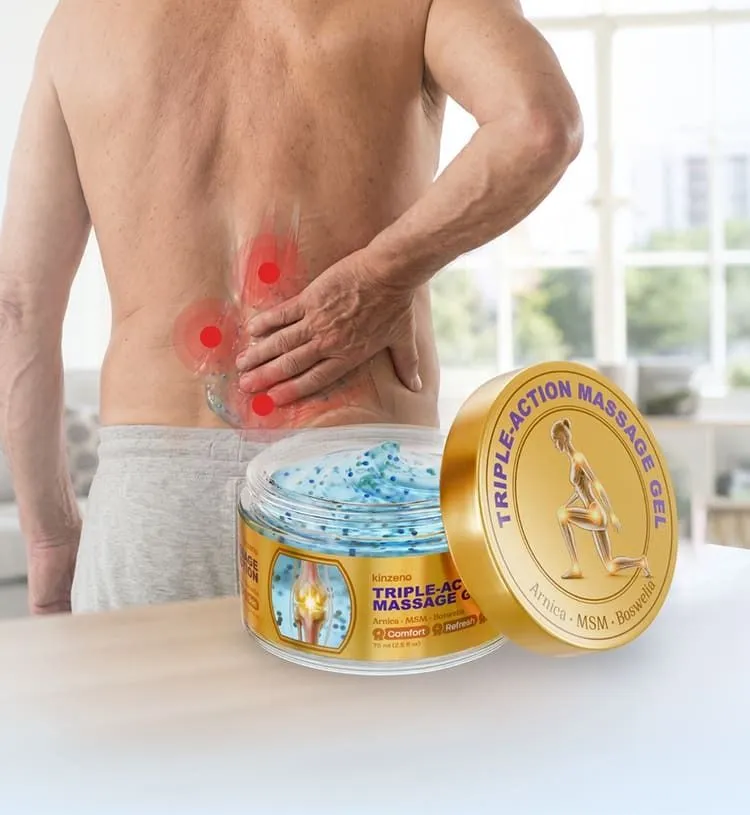
How to apply it: follow the label on any oral pain reliever and check with a pharmacist if you take other medication. The "applied to the skin" part is where a daily massage routine fits naturally: a cooling gel worked into the tight area for a minute or two gives you the sensation of relief and — just as importantly — makes you actually touch and move the sore muscles. If you want a drug-free option for that step, a cooling botanical massage gel such as Kinzeno Gel is the one we recommend, and our safe-use guide explains how it combines with pills and heat.
Recommendation 4: strengthen your back and core, and warm up first
Under prevention, NIAMS advises keeping back muscles strong and improving balance — it names tai chi, yoga and weight-bearing exercise — and tells you to warm up before exercise. On the treatment side it notes that physical therapy can strengthen the muscles that support the back, with the caveat: "Check with your doctor or physical therapist before starting any exercise routine."
How to apply it: you don't need a gym. Two or three short sessions a week of gentle core work (bird-dog, dead bug, glute bridges), a daily walk, and a five-minute warm-up before anything strenuous covers the spirit of the advice. If you're unsure where to start, our comparison of chiropractors, massage therapists and physical therapists explains who does what.
Recommendation 5: posture, lifting and the small daily habits
NIAMS's prevention and "living with back pain" sections read like a checklist of everyday habits:
- Practice good posture and avoid slouching.
- Avoid heavy lifting when you can; when you must lift, "use your leg and abdominal muscles instead of your back."
- Change positions often when sitting; on long drives, stop to walk and add support behind your lower back.
- Wear low-heeled, comfortable shoes.
- Carry smaller loads or make extra trips.
- Maintain a healthy weight, get enough calcium and vitamin D, and quit smoking.
- Build healthy habits around exercise, relaxation, regular sleep and a healthy diet.
How to apply it: pick the two that match your day. Desk worker? Set a 30-minute stand-up reminder and raise your screen. Driver? Rolled towel behind the lower back and a walk at every stop. Parent or weekend gardener? Knees bent, load close, no twisting. Our desk-job fixes and yard-work recovery articles go into detail.
Recommendation 6: sleep position
NIAMS is specific: sleep on your side with a pillow between your knees, or on your back with a pillow under your knees, and avoid sleeping on your stomach when possible.
How to apply it: a spare pillow is all it takes. If you wake up stiff most mornings, this is one of the highest-return changes you can make — see why you wake up stiff and sore.
Recommendation 7: know the warning signs
NIAMS says plainly: "You should see a doctor if your pain does not improve after a few weeks." See a doctor sooner if you have numbness or tingling, severe pain that doesn't improve with medication, pain after a fall or injury, or back pain together with trouble urinating, leg weakness or numbness, fever, or unintended weight loss.
How to apply it: read that list once now, so you recognize it if it happens. Everything else in this article is for pain without those signs.
The official guidance at a glance — and your daily routine
| What the NIH says | What to do today |
|---|---|
| Avoid bed rest; limit only what hurts | Keep walking and doing light tasks; skip the one movement that sharpens the pain |
| Cold packs; hot packs | Cold for the first 1–2 days of a strain; warmth for stiffness after that |
| OTC relief by mouth or on the skin | Follow labels; add a 1–2 minute massage with a gel over the tight area |
| Strengthen back and core; warm up | Short core sessions 2–3x a week; 5-minute warm-up before exertion |
| Posture, lifting with the legs, breaks | Stand up every 30 minutes; load close, knees bent, no twist |
| Side with pillow between knees, or back with pillow under knees | Add a spare pillow tonight; avoid stomach sleeping |
| See a doctor if no improvement in a few weeks or warning signs | Note your start date; know the red flags |
Put together, a realistic day looks like this: a warm shower and a minute of gentle movement in the morning, a short walk and a stand-up reminder through the workday, warmth or a massage gel on the tight area in the evening, and the right pillow at night. None of it is dramatic — which is exactly why it works when people stick to it.
Our recommendation: Kinzeno Gel
The NIH's guidance leaves one step to you: the hands-on, daily care of tight, sore muscles. The product we recommend for that step is Kinzeno Gel, a drug-free cooling massage gel that makes the "applied to the skin" part of the routine easy to keep up:
- Built for everyday muscular back pain: the maker describes a 3-phase action — a fast cooling sensation to relieve, magnesium and MSM to help restore tight muscles, and botanicals to renew comfort and easier movement.
- Familiar ingredients: MSM, arnica, magnesium and Boswellia (frankincense), plus skin-friendly allantoin and vitamin E — see our ingredients guide.
- Fits the routine above: massage a coin-sized amount into the sore area for a minute or two, up to 2–4 times a day — after your warm shower in the morning, or in the evening before bed.
- Non-greasy and drug-free: it absorbs without a film and doesn't add another pain medicine to your day.
Kinzeno Gel is sold through its official website, where the current promotion applies: $34.99 for one jar, $29.99 per jar in a 2-pack, $24.99 per jar in a 3-pack and $19.99 per jar in the 4-pack — up to 70% off. Ordering on the official site is the way to get the original product with the manufacturer's guarantee. Results vary from person to person, so use it consistently alongside the movement, heat and sleep habits above, patch-test it the first time, and follow your doctor's advice for any diagnosed condition.
Put the guidance into practice
Kinzeno Gel combines MSM, arnica, magnesium and Boswellia in a drug-free, non-greasy cooling massage gel — and the official site is running a limited-time deal of up to 70% off right now.
See the Kinzeno deal (up to 70% off) → Or read our full Kinzeno Gel review first →Frequently asked questions
Does the NIH recommend bed rest for back pain?
No. The NIH's NIAMS page on back pain treatment says to avoid bed rest and instead limit only the activities that cause pain, and MedlinePlus warns that staying in bed for more than one or two days can make back pain worse. Gentle, regular movement is the recommended approach for most everyday back pain.
Should I use heat or cold on my back according to official guidance?
Both have a place. NIAMS lists cold packs to help relieve some back pain and hot packs to support blood flow and healing. In practice, cold is most useful in the first day or two after a fresh strain, and heat is most useful for stiffness and tightness. Never use a heating pad on top of a topical gel.
How long does back pain usually last?
NIAMS says most people find relief within six weeks. It defines acute back pain as lasting a few days to a few weeks, subacute as 4 to 12 weeks, and chronic as lasting longer than 12 weeks. MedlinePlus advises contacting a health care provider if pain is severe or does not improve after three days.
What sleeping position does the NIH suggest for back pain?
NIAMS suggests sleeping on your side with a pillow between your knees, or on your back with a pillow under your knees, and avoiding sleeping on your stomach when possible.
When does official guidance say to see a doctor for back pain?
See a doctor if the pain does not improve after a few weeks, if you have numbness or tingling, severe pain that does not improve with medication, pain after a fall or injury, or pain together with trouble urinating, leg weakness or numbness, fever or unintended weight loss.
Does a massage gel like Kinzeno fit the official recommendations?
The NIH lists over-the-counter pain relievers applied to the skin among treatment options and highlights staying active and gentle self-care. A drug-free cooling massage gel such as Kinzeno Gel is a practical way to do the daily massage step for everyday muscular back pain; it is not a medicine and does not replace your doctor's advice.
Give your back one minute a day
Get Kinzeno Gel from the official site while the up-to-70%-off deal lasts.
Get Kinzeno Gel →