Back Pain Terms Explained: 12 Words You'll Hear From Your Doctor (in Plain English)
You leave the appointment, or close the MRI report, with a handful of new words: nonspecific, bulging disc, radiculopathy, degenerative changes. Some sound harmless, some sound alarming, and most come without much explanation. It's no wonder so many people go home more worried than when they arrived.
This glossary translates the 12 back pain terms Americans hear most often into plain English — what each one means, what it usually means for you, and a good question to ask your doctor. It's general information, not medical advice, and it doesn't replace a conversation with the clinician who examined you.
Terms about how long it has lasted
1. Acute, subacute and chronic
These describe time, not severity. Back pain is usually called acute when it has lasted less than about 4 weeks, subacute between roughly 4 and 12 weeks, and chronic when it has gone on for more than about 12 weeks (three months). "Chronic" does not mean "permanent" or "serious" — it simply means it has been around for a while and deserves a proper plan.
Ask your doctor: "Since this has lasted this long, what should my plan look like for the next few weeks?"
2. Nonspecific low back pain
This is the label for the large majority of back pain cases: pain that comes from the muscles, ligaments and joints of the back without one single identifiable cause such as a fracture, an infection or a compressed nerve. It can sound like "we don't know what's wrong," but it's actually reassuring — it means no serious cause was found, and it usually improves with staying active and simple self-care.
Ask your doctor: "What can I do day to day to help it settle and stop it coming back?"
Terms about muscles and soft tissue
3. Strain vs. sprain
They sound alike but point to different tissues. A strain is an overstretched or overworked muscle or tendon — the classic result of lifting, twisting or a weekend of yard work. A sprain is an overstretched ligament, the tough bands that connect bones. In the lower back the two often happen together and are handled in much the same way: a short break from heavy lifting, then a gradual return to normal movement.
4. Muscle spasm
A spasm is a sudden, involuntary tightening of a muscle. In the back it often feels like the area has "locked" or "seized," and it can be intense. Spasm is usually the body's way of guarding a sore area. Gentle movement, warmth and slow massage help the muscle let go.
5. Trigger point (muscle knot)
A trigger point is a small, tender, tight spot within a muscle — what most people call a "knot." Pressing it can hurt locally or send a dull ache somewhere nearby. Trigger points are common in the upper back, shoulders and around the hips, and they typically respond well to steady pressure, warmth and massage.
These three terms — strain, spasm and trigger point — describe the everyday, muscular side of back pain. That's exactly where a few minutes of daily massage with a drug-free gel like Kinzeno Gel fits naturally into a routine.
Terms about discs and nerves
6. Bulging disc
Between each pair of vertebrae sits a disc: a tough outer ring with a softer, gel-like center, acting as a cushion. A bulging disc means the disc extends a little beyond its normal edge, a bit like a hamburger patty that's wider than the bun. Bulging discs become more common with age and are often found on scans of people who have no back pain at all.
7. Herniated disc (also "slipped" or "ruptured" disc)
In a herniated disc, some of the soft inner material pushes out through a tear in the outer ring. Despite the nickname, nothing actually "slips." A herniation may cause no symptoms, or it may press on or irritate a nearby nerve root. Many herniated discs improve over time with conservative care, and your doctor will guide you on activity.
Ask your doctor: "Is the disc finding actually what's causing my symptoms?"
8. Sciatica
Sciatica is not a diagnosis of its own — it's a description of pain that travels along the path of the sciatic nerve: from the lower back or buttock down the back of the leg, sometimes to the foot. It's often caused by an irritated nerve root in the lower spine. Pain that stays only in the back is usually not sciatica.
9. Radiculopathy (a "pinched nerve")
Radiculopathy means a nerve root is irritated or compressed and that this is affecting how the nerve works — for example numbness, tingling or weakness in an arm or leg. In the lower back it's called lumbar radiculopathy; in the neck, cervical radiculopathy. New weakness or spreading numbness is a reason to see a doctor promptly.
10. Referred pain
Referred pain is felt in a different place from where it starts. A tight muscle or joint in the lower back can produce a deep, dull ache in the buttock or upper thigh, for instance. Referred pain from muscles and joints usually doesn't come with numbness or weakness — which is one way clinicians tell it apart from nerve-root pain.
Terms you might see on a scan report
11. Degenerative disc disease (and "degenerative changes")
Despite the frightening name, degenerative disc disease mostly describes the normal, age-related wear of the discs — they lose water and thin a little over the years. These changes are extremely common on imaging as we get older, including in people with no pain, so they don't necessarily explain your symptoms. Think of it more like gray hair for your spine than a disease that "spreads."
12. Red flags
Red flags are the warning signs doctors check for to rule out a serious cause: loss of bladder or bowel control, numbness in the groin or inner thighs, sudden leg weakness, back pain after a fall or accident, fever, unexplained weight loss, or a history of cancer. If your doctor says "no red flags," that's good news — it means home care and staying active are the right starting point.
All 12 terms at a glance
| Term | In plain English | What it usually means for you |
|---|---|---|
| Acute / subacute / chronic | Under 4 weeks / 4–12 weeks / over 12 weeks | A time label, not a severity label |
| Nonspecific low back pain | Everyday mechanical pain, no single cause | Reassuring; stay active, build a routine |
| Strain / sprain | Overworked muscle / stretched ligament | Short break from heavy lifting, then move |
| Muscle spasm | Sudden involuntary tightening | Warmth, gentle movement, slow massage |
| Trigger point | Tender "knot" in a muscle | Steady pressure and massage help |
| Bulging disc | Disc extends past its edge | Common with age, often painless |
| Herniated disc | Inner disc material pushes out | May or may not cause symptoms |
| Sciatica | Pain along the sciatic nerve down the leg | A symptom description, not a diagnosis |
| Radiculopathy | Irritated nerve root affecting function | Numbness or weakness: see a doctor |
| Referred pain | Felt away from the source | Often muscular or joint-related |
| Degenerative disc disease | Age-related disc wear | Very common on scans, not always the cause |
| Red flags | Warning signs of a serious cause | None? Home care is the right start |
What to do with your new vocabulary
Knowing the words helps you have a calmer, more useful conversation. If your diagnosis is nonspecific or muscular — strain, spasm, trigger points — the plan for most people is refreshingly simple: keep moving, use warmth for stiffness, take breaks from long sitting and add a minute or two of massage over the tight area once or twice a day. For help choosing between providers, see chiropractor, massage or physical therapy, and for heat vs. cold, see heat or ice for back pain.
If any red flag applies to you, or you have numbness, tingling or weakness in a leg, don't wait — see your doctor.
Our recommendation: Kinzeno Gel
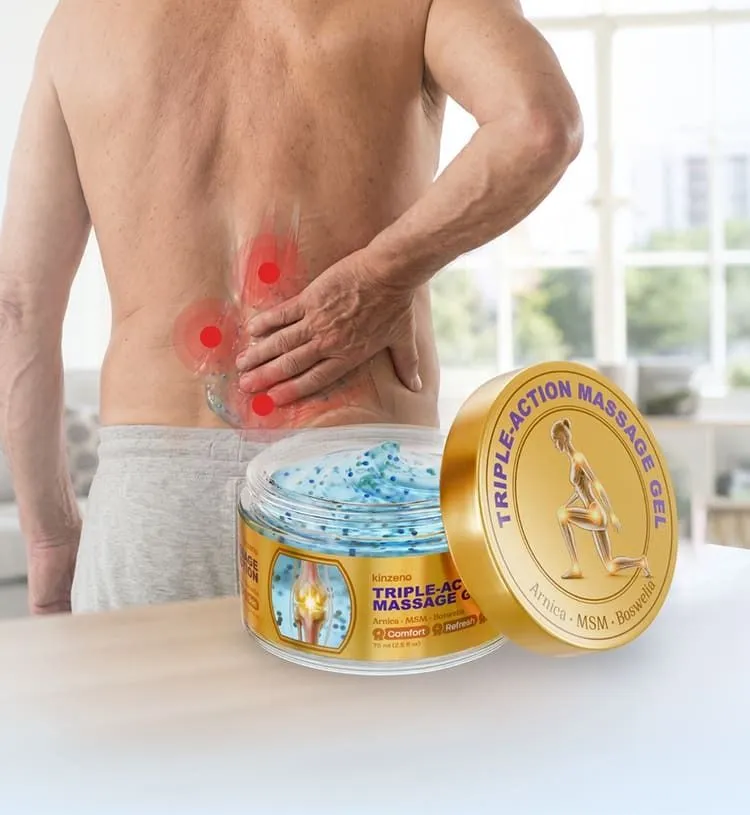
For the everyday muscular side of back pain — the strains, spasms and knots in this glossary — the product we recommend is Kinzeno Gel. It's a drug-free cooling massage gel made for exactly the daily massage step that most routines skip:
- Made for tight, tired muscles: the maker describes a 3-phase action — a fast cooling sensation to relieve, magnesium and MSM to help restore tight muscles, and botanicals to renew comfort and easier movement.
- Familiar ingredients: MSM, arnica, magnesium and Boswellia (frankincense), plus skin-friendly allantoin and vitamin E — see our ingredients guide.
- One minute, not an afternoon: massage a coin-sized amount into the sore area for a minute or two, up to 2–4 times a day as needed.
- Non-greasy and drug-free: it absorbs without a film and doesn't add another pain medicine to your day.
Kinzeno Gel is sold through its official website, where the current promotion applies: $34.99 for one jar, $29.99 per jar in a 2-pack, $24.99 per jar in a 3-pack and $19.99 per jar in the 4-pack — up to 70% off. Ordering on the official site is the way to get the original product with the manufacturer's guarantee. Results vary from person to person, so use it consistently alongside gentle movement, patch-test it the first time, and follow your doctor's advice for any diagnosed condition.
Put the plan into practice
Kinzeno Gel combines MSM, arnica, magnesium and Boswellia in a drug-free, non-greasy cooling massage gel — and the official site is running a limited-time deal of up to 70% off right now.
See the Kinzeno deal (up to 70% off) → Or read our full Kinzeno Gel review first →Frequently asked questions
What does nonspecific low back pain mean?
It means back pain that comes from the muscles, ligaments and joints of the back without one single identifiable cause such as a fracture, infection or compressed nerve. It covers the large majority of back pain cases and usually improves with staying active and simple self-care.
What is the difference between a bulging disc and a herniated disc?
In a bulging disc, the disc extends a little beyond its normal edge while its outer ring stays intact. In a herniated disc, some of the soft inner material pushes out through a tear in the outer ring. Both are common on scans, and both can be present without causing any pain.
Is sciatica the same as a pinched nerve?
Not exactly. Sciatica describes pain that travels along the sciatic nerve from the lower back or buttock down the leg. A pinched nerve, or radiculopathy, means a nerve root is irritated or compressed and is affecting how the nerve works. Sciatica is often caused by an irritated nerve root in the lower spine.
Should I worry if my MRI says degenerative disc disease?
Usually not on its own. The term mostly describes age-related wear of the discs, which is very common on imaging as people get older, including in people without pain. Ask your doctor whether the finding actually matches your symptoms.
When does back pain count as chronic?
Back pain is generally called chronic when it has lasted more than about 12 weeks, or three months. It describes duration, not severity, and it is a good reason to work with your doctor or a physical therapist on a plan. See also what happens if you ignore back pain.
Can Kinzeno Gel help with muscle strains and knots?
Kinzeno Gel is a drug-free cooling massage gel made for everyday muscular discomfort. Massaging a coin-sized amount into the tight area for a minute or two, up to 2 to 4 times a day, makes the daily massage step easy. Use it on intact skin, patch-test it the first time and see a doctor if you have any red flag.
Give your back one minute a day
Get Kinzeno Gel from the official site while the up-to-70%-off deal lasts.
Get Kinzeno Gel →